




Anjali
Introduction
Corrosion protection is critical across automotive, construction, renewable energy, railways, and heavy engineering. Two of the most common ways to protect steel fasteners and components are zinc flake coating and zinc plating (electroplating). Both put a layer of zinc between the steel and the environment, but they differ sharply in how they are applied, how much corrosion resistance they provide, and — crucially — how they affect high-strength parts.
This guide compares zinc flake coating and zinc plating so you can choose the right method for your application.
What Is Zinc Flake Coating?
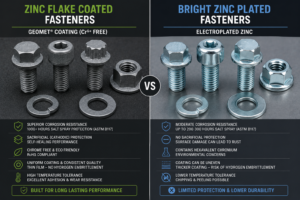
Zinc flake coating is a non-electrolytic system made of microscopic zinc and aluminium flakes suspended in a binder, applied by dip-spin or spray and heat-cured into a thin, durable layer. Because it uses no electric current and no acid electro-deposition, it does not generate hydrogen during application — making it ideal for high-strength fasteners and safety-critical parts.
Key benefits of zinc flake coating:
- Superior corrosion resistance (500–2,000+ hrs salt spray)
- Chromium-free formulations
- No hydrogen embrittlement
- Excellent thread compatibility
- Controlled friction characteristics
- OEM-approved for automotive applications
It is widely used on automotive fasteners, chassis components, wind energy hardware, railways, and industrial assemblies.
What Is Zinc Plating?
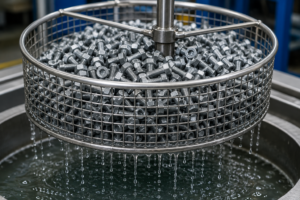
Zinc plating (electro-galvanizing) deposits a thin layer of zinc onto steel using an electrolytic process: parts are immersed in a zinc-salt bath and an electric current drives zinc onto the surface. A passivation treatment — increasingly trivalent, Cr(III), to meet RoHS and REACH — and sometimes a sealant are then applied to improve corrosion resistance and appearance.
Zinc plating produces a bright, uniform, low-cost finish with close dimensional tolerances, which is why it remains popular for small fasteners, brackets, and general hardware used in mild indoor environments.
Key benefits of zinc plating:
- Low initial cost
- Bright, attractive finish
- Excellent for small, fine-thread parts and close tolerances
- Good for indoor / mild-environment applications
- Uniform thin deposit
How They Work
Zinc flake coating — a thin, non-electrol
ytic layer of overlapping zinc and aluminium flakes providing barrier protection, sacrificial galvanic protection, and self-healing, with controlled friction and precise thickness.
Zinc plating — an electrolytically deposited zinc layer that provides sacrificial protection; corrosion life depends heavily on the passivation and any sealant applied, and on coating thickness.
Manufacturing Process Comparison
Zinc flake: cleaning → degreasing → shot blasting/pretreatment → dip-spin or spray → flash-off drying → controlled curing → thickness inspection → salt spray testing → quality inspection.
Zinc plating: cleaning → acid pickling → electrolytic zinc deposition → rinsing → passivation → optional sealant → drying → inspection.
The key difference: zinc plating uses acid pickling and electric current, both of which can drive hydrogen into the steel. Zinc flake uses neither.
Coating Thickness
| Property | Zinc Flake Coating | Zinc Plating |
|---|---|---|
| Typical thickness | 8–20 µm | 5–25 µm |
| Dimensional accuracy | Excellent | Excellent |
| Thread compatibility | Excellent | Excellent (very fine threads) |
| Precision components | Highly suitable | Highly suitable |
Both are thin systems. Zinc plating can achieve very close tolerances and bright finishes on small parts, while zinc flake delivers more corrosion resistance per micron.
Corrosion Resistance
Corrosion resistance is evaluated using ASTM B117 or ISO 9227 salt spray testing.
| Property | Zinc Flake Coating | Zinc Plating |
|---|---|---|
| Red rust | 500–2,000+ hrs | ~48–200 hrs (up to ~500 with premium seal) |
| White rust resistance | Excellent | Moderate |
| Outdoor durability | Excellent | Limited |
| Automotive durability | Excellent | Limited (mild environments) |
Zinc flake provides dramatically higher corrosion resistance for the same thickness, which is why OEMs specify it for demanding environments. Zinc-nickel alloy plating narrows the gap but at higher cost and complexity.
Hydrogen Embrittlement
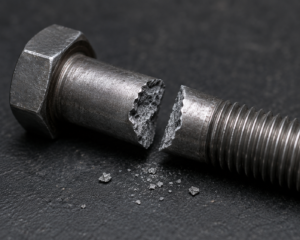
This is the most important difference for high-strength parts. Zinc plating involves acid pickling and electrolysis, both of which can introduce hydrogen into the steel. In high-strength fasteners (typically grade 10.9 / 12.9 or steels at or above 1,000 MPa), absorbed hydrogen can cause delayed, sudden brittle failure. Plated high-strength parts therefore require a controlled post-plating bake (de-embrittlement) — and even then, the risk can only be reduced, not eliminated.
Zinc flake coating is non-electrolytic and uses no acid electro-deposition, so it does not introduce hydrogen embrittlement during coating. For safety-critical, high-strength fasteners, this makes zinc flake the safer choice — and it is a primary reason automotive OEMs have moved away from electroplating on such parts.
Appearance & Finish
Zinc plating: bright, uniform, decorative silver (or coloured passivation) finish — often preferred where appearance matters and the environment is mild.
Zinc flake: matte silver-grey (or black with topcoat) finish optimised for performance rather than brightness.
Torque & Thread Consistency
Zinc plating gives a thin, uniform deposit and generally good thread fit, though bare plating friction can vary without an added lubricant. Zinc flake systems typically include an integrated or topcoat lubricant that delivers a controlled, repeatable coefficient of friction and consistent torque-tension behaviour — valuable for automated assembly of critical joints.
Applications at a Glance
| Application | Zinc Flake Coating | Zinc Plating |
|---|---|---|
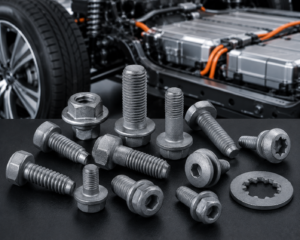
| Automotive fasteners, chassis, EV parts | Excellent | Limited |
| High-strength / safety-critical bolts | Excellent | Not recommended (HE risk) |
| Wind energy & outdoor hardware | Excellent | Limited |
| Indoor brackets & general hardware | Suitable | Excellent |
| Small, fine-thread decorative parts | Suitable | Excellent |
| Cost-sensitive, mild-environment parts | Higher cost | Excellent |
Cost Comparison
| Cost factor | Zinc Flake Coating | Zinc Plating |
|---|---|---|
| Initial cost | Medium–High | Low |
| Corrosion life | High | Low–Medium |
| Maintenance / replacement | Low | Higher in demanding use |
| Lifecycle cost | Lower for demanding use | Low for mild indoor use |
Zinc plating is cheaper upfront and ideal for mild environments; zinc flake’s far higher corrosion resistance and freedom from hydrogen embrittlement make it more economical over the lifecycle for demanding or safety-critical parts.
Complete Comparison Table
| Property | Zinc Flake Coating | Zinc Plating |
|---|---|---|
| Process | Non-electrolytic (dip-spin/spray, cured) | Electrolytic (electroplated) |
| Thickness | 8–20 µm | 5–25 µm |
| Salt spray (red rust) | 500–2,000+ hrs | ~48–200 hrs (more with seal) |
| Hydrogen embrittlement | None during coating | Risk; needs de-embrittlement bake |
| High-strength fasteners | Excellent | Not recommended |
| Appearance | Matte silver-grey / black | Bright, decorative |
| Thread fit | Excellent (controlled friction) | Good; very fine threads |
| Outdoor / automotive durability | Excellent | Limited |
| Initial cost | Medium–High | Low |
| Environmental compliance | Chromium-free; REACH/RoHS/ELV | Cr(III) passivation for compliance |
Which Coating Should You Choose?
Choose zinc flake coating for automotive fasteners, high-strength and safety-critical parts, outdoor and renewable-energy hardware, and any application needing high corrosion resistance with no hydrogen embrittlement risk.
Choose zinc plating for small, cost-sensitive parts, decorative bright finishes, fine-thread components, and general hardware used in mild indoor environments.
Frequently Asked Questions
Is zinc flake coating better than zinc plating? For high-strength fasteners, automotive parts, and demanding or outdoor environments, zinc flake is generally preferred for its far higher corrosion resistance and freedom from hydrogen embrittlement. Zinc plating is a cost-effective choice for small, decorative, or mild-environment parts.
Does zinc plating cause hydrogen embrittlement? It can. The acid pickling and electrolytic process can drive hydrogen into steel; high-strength plated parts need a de-embrittlement bake, and even then the risk is only reduced. Zinc flake avoids this entirely.
Which lasts longer? Zinc flake typically offers 500–2,000+ hours of salt spray resistance versus roughly 48–200 hours for standard zinc plating (more with premium passivation and sealants), so zinc flake generally lasts far longer in corrosive conditions.
Which is more environmentally friendly? Modern zinc flake coatings are chromium-free and comply with REACH, RoHS, and ELV. Zinc plating can be compliant when using trivalent (Cr(III)) passivation.
Is zinc plating good for outdoor use? Standard zinc plating has limited outdoor durability; for outdoor, automotive, or safety-critical use, zinc flake (or another high-performance system) is usually specified.
Conclusion
Zinc flake coating and zinc plating both protect steel with zinc, but they suit very different needs. Zinc plating is inexpensive, bright, and well suited to small parts and mild indoor environments. Zinc flake coating delivers far higher corrosion resistance, controlled friction, and — critically — no hydrogen embrittlement, making it the preferred choice for automotive fasteners, high-strength parts, and demanding or outdoor applications.
At Aum Dacro Coatings, we specialise in advanced zinc flake coating solutions that meet global OEM specifications across automotive, wind energy, heavy engineering, and infrastructure — helping you improve reliability, extend service life, and reduce maintenance costs.