




Anjali
Zinc Flake Coating Inspection: What to Check Before Approving a Coated Lot
When it comes to corrosion protection, appearance alone is not enough to determine whether a coating will perform as expected. Many manufacturers invest in zinc flake coating to protect fasteners, brackets, springs, and engineered components from harsh environmental conditions. However, the actual performance of a coating depends on consistent application, proper testing, and documented quality controls.
This is where zinc flake coating inspection becomes critical.
Many coating-related defects are invisible to the naked eye. A component may look acceptable while suffering from incorrect coating weight, inconsistent thickness, poor adhesion, inadequate curing, or insufficient corrosion resistance. Without proper inspection records and traceable quality documentation, it becomes difficult to verify whether the coating applied meets the required specifications.
Understanding what to check before approving a coated lot can help manufacturers avoid quality issues, premature corrosion, warranty claims, and customer dissatisfaction.
Why Zinc Flake Coating Inspection Matters
Zinc flake coatings are designed to provide long-term corrosion protection without hydrogen embrittlement risks commonly associated with electroplating. These coatings are widely used in automotive, renewable energy, construction, infrastructure, and industrial applications where component reliability is essential.
However, even the best coating chemistry cannot deliver expected performance if the coating process is not properly controlled.
Poor zinc flake coating inspection can lead to:
- Premature rust formation
- Inconsistent corrosion resistance
- Poor adhesion
- Excessive coating build-up
- Assembly and fitment issues
- Reduced product life
- Customer complaints and field failures
For this reason, manufacturers should evaluate not only the coating supplier but also the quality assurance processes supporting the coating operation.
Common Issues That Affect Zinc Flake Coating Inspection
Several factors can impact coating performance if they are not properly monitored and controlled.
Incorrect Coating Weight
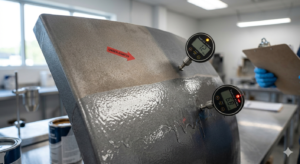
Coating weight directly influences corrosion resistance. If the coating weight is below specification, the protective barrier may not provide the expected service life.
Excessive coating weight can also create problems by affecting dimensional tolerances and assembly requirements.
Regular verification of coating weight is an important indicator of overall zinc flake coating quality.
Inconsistent Coating Thickness
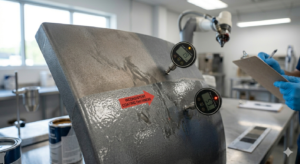
Uniform coating thickness ensures that all surfaces receive adequate protection.
Variations in thickness may lead to weak points where corrosion begins earlier than expected. Thickness measurement helps confirm that the coating process remains stable and compliant with customer specifications.
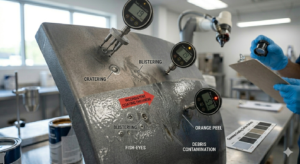
Surface Defects
Certain coating defects may reduce performance even if they appear minor.
Examples include:
- Blisters
- Wrinkles
- Cracks
- Uneven coating distribution
- Surface contamination
- Colour variations
Visual inspection remains an important part of maintaining zinc flake coating quality and identifying process deviations before shipment.
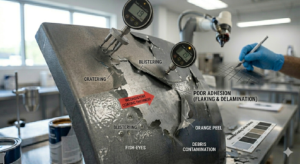
Poor Adhesion
Adhesion problems can result in coating damage during transportation, assembly, or service.
Proper surface preparation, controlled application, and process validation help ensure that coatings remain bonded to the substrate throughout their intended service life.
Key Checks to Request From Your Job Coater
Before approving any coated lot, customers should request documented evidence of coating quality rather than relying solely on visual appearance.
1. Coating Weight Verification
A reliable coating supplier should be able to provide coating weight measurements for each production lot.
These records help verify that the coating process is operating within the required specification and that sufficient protection has been applied.
2. Coating Thickness Measurement
Thickness verification is one of the most important quality checks in zinc flake coating applications.
Documented thickness measurements provide confidence that the coating has been applied consistently across the production batch.
3. Visual Zinc Flake Coating Inspection Reports
Visual inspection should be conducted to identify any defects that may affect coating performance or appearance.
Inspection records should document acceptance criteria and quality approval status before dispatch.
4. Corrosion Resistance Validation
Corrosion testing plays a vital role in verifying zinc flake coating quality.
Many manufacturers use ASTM B117 salt spray testing to evaluate coating performance under accelerated corrosive conditions.
Customers should confirm that corrosion testing is conducted according to applicable specifications and that testing records are available when required.
5. Traceable PDI Reports
A Pre-Dispatch Inspection (PDI) report serves as documented proof that the lot has undergone quality verification before shipment.
An effective PDI report should include:
- Lot number
- Inspection status
- Test results
- Quality approval details
- Traceability records
Digital PDI systems further improve transparency and reduce the risk of documentation errors.

The Growing Importance of Digital Traceability
Modern manufacturing increasingly demands visibility and accountability throughout the supply chain.
Digital traceability enables manufacturers to track inspection results, testing records, and production history for each coated lot.
Benefits of digital traceability include:
- Faster quality verification
- Improved record management
- Reduced documentation errors
- Better customer confidence
- Simplified audits and compliance reviews
As quality requirements continue to evolve, digital quality systems are becoming a key differentiator among zinc flake coating suppliers.
Zinc Flake Coating Inspection in Critical Industries
Industries such as automotive, solar energy, wind energy, infrastructure, and heavy engineering rely heavily on corrosion-resistant coatings.
In these sectors, component failure can result in significant operational and financial consequences.
This makes zinc flake coating quality a critical consideration for:
- Fasteners
- Structural hardware
- Solar mounting systems
- Automotive components
- Industrial assemblies
- High-strength bolts and nuts
Selecting a coating partner with robust inspection and quality systems helps reduce long-term risk while supporting product reliability.
How Aum Dacro Ensures Zinc Flake Coating Inspection
At Aum Dacro, quality assurance is integrated throughout the coating process to ensure consistency, traceability, and confidence.
Our quality framework includes:
- Coating weight verification
- Thickness measurement and validation
- Lot-wise inspection controls
- Visual defect inspection
- Salt spray testing validation
- QA-approved digital PDI reports
- Customer-accessible traceability systems
- NOF-licensed Geomet® coating technology
By combining advanced coating technology with documented inspection procedures, we provide customers with measurable proof of coating performance.
Our approach is built on transparency, accountability, and continuous quality improvement.

Zinc Flake Coating Inspection Checklist: What Customers Should Verify
| Quality Parameter | Why It Matters | What to Ask Your Job Coater |
|---|---|---|
| Coating Weight Verification | Ensures adequate corrosion protection and coating consistency | Is coating weight measured and recorded for every production lot? |
| Coating Thickness Measurement | Helps maintain uniform protection and dimensional compliance | Can you provide thickness reports for my lot? |
| Visual Inspection | Identifies defects that may affect performance or appearance | Are parts inspected for blisters, wrinkles, cracks, and colour variations? |
| Corrosion Resistance Testing | Confirms long-term protection against rust and environmental exposure | Is ASTM B117 salt spray testing performed and documented? |
| Adhesion Validation | Ensures coating remains intact during handling and service | How is coating adhesion verified? |
| Lot Traceability | Enables root-cause analysis and quality verification | Can inspection records be traced back to a specific lot? |
| PDI Report Availability | Provides documented proof of inspection before dispatch | Will I receive a QA-approved PDI report? |
| Digital Quality Records | Improves transparency and prevents record tampering | Are inspection records maintained digitally? |
| Process Standardization | Ensures consistency across batches and production runs | Are coating processes standardized and controlled? |
| Coating Technology Used | Impacts overall coating performance and durability | Which zinc flake coating system is being applied? |
Authentic Zinc Flake Coating vs Unverified Coating
| Parameter | Authentic Zinc Flake Coating | Unverified Coating |
|---|---|---|
| Coating Weight Data | Available and documented | Often unavailable |
| Thickness Verification | Measured and recorded | Not always verified |
| ASTM B117 Test Records | Available on request | Rarely provided |
| PDI Reports | QA-approved and traceable | Generic or missing |
| Lot Traceability | Complete production traceability | Limited visibility |
| Quality Documentation | Digital and auditable | Manual or incomplete |
| Corrosion Performance Validation | Supported by testing data | Based on assumptions |
| Customer Confidence | High | Uncertain |
Zinc Flake Coating: Frequently Asked Questions
What is zinc flake coating?
Zinc flake coating is a non-electrolytic corrosion-protection system made of overlapping zinc and aluminium flakes bound in an inorganic matrix. Parts are dip-spin coated and heat cured (typically 180–330°C), forming a thin barrier and sacrificial layer that protects steel against rust. It is widely used on fasteners, brackets, springs, and high-strength components.
How many salt spray hours should a zinc flake coating achieve?
Performance is measured to ASTM B117 / ISO 9227 and reported as hours to red rust. Zinc flake coating systems typically deliver between 480 and 1,000+ hours, with 720 hours being a common automotive benchmark. The exact figure depends on the number of layers, topcoat, and thickness applied.
What is the typical thickness of a zinc flake coating?
Most zinc flake coating systems are applied at 8–12 µm, including base coat and topcoat. Thickness is verified non-destructively and directly influences corrosion resistance, so it should be measured and recorded for every production lot.
Does zinc flake coating cause hydrogen embrittlement?
No. Because zinc flake coating is applied by a dip-spin and bake process rather than electroplating, there is no hydrogen charging of the substrate. This makes it the preferred choice for high-strength steel fasteners where hydrogen embrittlement is a concern.
How is the friction of a zinc flake coating controlled?
An integrated topcoat or lubricant gives a controlled coefficient of friction, typically in the 0.09–0.15 range when tested to ISO 16047. This ensures a predictable torque-tension relationship during assembly, which is critical for bolted joints.
How do I verify the quality of a zinc flake coating lot?
Ask your job coater for documented coating weight and thickness measurements, ASTM B117 salt spray test records, visual inspection approval, lot traceability, and a QA-approved PDI report. Reliable quality is measured and traceable, not assumed.
Quick Buyer Checklist
Before approving your next coated lot, verify:
☑ Coating weight report
☑ Coating thickness report
☑ Visual inspection approval
☑ ASTM B117 corrosion test validation
☑ QA-approved PDI report
☑ Lot traceability records
☑ Digital quality documentation
Conclusion
High-quality zinc flake coatings are not defined by appearance alone. True zinc flake coating inspection is demonstrated through inspection records, coating weight verification, thickness measurement, corrosion testing, and complete traceability.
Before approving your next coated lot, ask for the data behind the coating. Reliable quality documentation helps ensure that components receive the corrosion protection they were designed to achieve.
At Aum Dacro, we believe that coating quality should never be assumed. It should be measured, validated, and fully traceable.
Because when corrosion protection matters, proof matters too.
For more Information – CLICK ME!