Theodore Lowe, Ap #867-859 Sit Rd, Azusa New York
We are available 24/ 7. Call Now. (888) 456-2790 (121) 255-53333 example@domain.comCoating
We design and develop web and mobile applications for our clients worldwide
Coatings
Overview
Zinc flake coatings consist of a combination of zinc and aluminum flakes suspended in a binder or resin matrix. The flakes form a layered structure on the surface, creating a barrier that shields the metal from environmental factors such as moisture, salt spray, and chemicals. This layered structure also offers cathodic protection to the underlying metal, which means that even if the coating is damaged or scratched, the zinc flakes sacrificially corrode instead of the metal substrate, providing an added level of protection.
These coatings are typically applied using a spray or dip process and then cured through heat or air drying. They can be used as standalone coatings or as part of a multilayer coating system, where they serve as a base layer for additional paint or powder coatings.
How it works?
Barrier effect
The positioning of the zinc flakes gives the film a barrier effect that isolates the metal from the corrosive environment. Indeed the flake morphology increases the length of the path that the aggressive substances must travel to reach and corrode the substrate.
Sacrificial protection
When steel is coated with zinc flake, cathodic protection is achieved. Because of its lower electrochemical potential, compared to iron, zinc oxidizes preferentially: it “sacrifices” itself to protect the steel substrate.
Self Healing
The cathodic protection of zinc produces various kinds of salts (oxides, hydroxides, carbonates…), also known as “white rust”. Thanks to their mobility and adherence properties, these compounds heal the damaged areas of the coating and therefore act as a corrosion inhibitor to protect the substrate.
Adhesion to substrate
Our zinc flake sol-gel binders create strong covalent bonds with the substrate, which ensures excellent adhesion. In addition, at the interface, the migration of corrosion precursors (O2 and H2O) becomes more difficult, which reinforces the barrier effect of the coating.
Torquer Series
Preventing looseness / Cost reduction / Weight reduction The Torquer Series is effective in every situation
Increasing the size and number of bottles is not enough to prevent loosening.
Combined with our zinc flake basecoats, ECHOTE® WH700 reacts and creates a barrier effect that improves both the corrosion resistance of the system and the galvanic corrosion protection with aluminum and different noble metals.
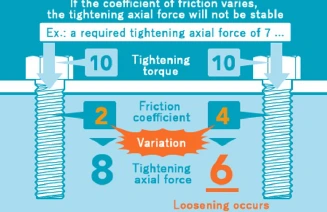
The most effective way to prevent loosening is to stabilize the coefficient of friction and exert an appropriate tightening axial force.
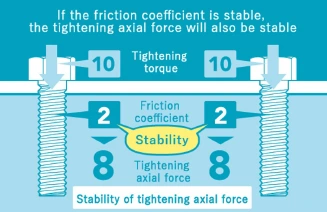
01. Stable fasteninig axial force prevent looseness
When the friction coefficient it stable, it is possible to obtain a stable tightening axial force without any variantion in all bolts when tightening with the same tightening torque.
02. A stable friction coefficient
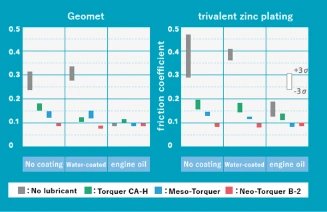
Applying the Torquer Series reduses the variation in the friction coefficient and makes it stable. We offer 3 types of lineups that allow you to choose the one that suits your needs best.
03. Maximize the utilization of bolts without sacrificing performance
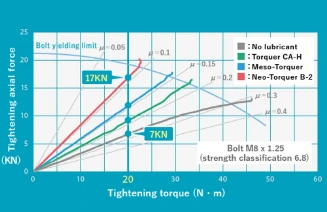
When the tightening torque is 20N*m, with M8 x 1.25 bolts (strength classification 6.8), only 7KN of tightening axial force can be obtained with non-lubricated bolts. However, when Neotorquer is applied, a tightening axial force of 17KN can be obtained.
In this way the Torquer series can maximize bolt performance.
04. No more increasing the size ir the number of bolts
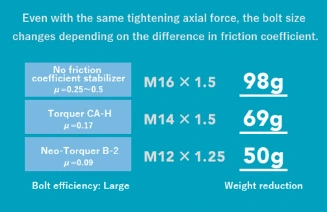
Until now, it was necessary to increase the size and number of bolts in order to obtain the required tightening axial force. By using the Torquer series, more tightening axial force can be obtained. As a result, it is possible to reduce the size and number of bolts, thus reducing both the cost and the overall weight.
- PLUS® VL
- PLUS® VLh
- PLUS® ML
PLUS® VL
- water based formulation
- clear color
- low thickness
Lubricant
PLUS® VL allows to obtain a stable and controlled friction coefficient in the range of 0.09-0.14.
0.09-0.14
Coefficient of friction (ISO 16047)
Corrosion protection
Combined with our zinc flake basecoats, PLUS® VL reacts and creates a barrier effect that improves both the corrosion resistance of the system and the contact corrosion with aluminum and other materials.
Chemical resistance
Resistance to industrial solvents and automotive fluids.
Color tracing
PLUS® VL can be colored for part visual identification and differentiation.
No hydrogen embrittlement
Implemented via non-electrolytic application processes. This avoids the hydrogen embrittlement phenomenon that causes cracking of metals.
PLUS® VL
- water based formulation
- clear color
- low thickness
Lubricantion
PLUS® VLh allows to obtain a stable and controlled friction coefficient in the range of 0.09-0.14. It provides outstanding tribological performances and stability regarding multi-tightening with various counterparts materials (cataphoretic paint, aluminum alloys, cast iron and steel) while avoiding stick-slip problems. It also offers excellent behaviour in loosening tests, including at high temperature.
0.09-0.14
Coefficient of friction (ISO 16047)
Corrosion protection
Combined with our zinc flake basecoats, PLUS® VLh reacts and creates a barrier effect that improves both the corrosion resistance of the system and the contact corrosion with aluminum and other materials.
Chemical resistance
Resistance to industrial solvents and automotive fluids.
Color tracing
PLUS® VLh can be colored for part visual identification and differentiation.
No hydrogen embrittlement
Implemented via non-electrolytic application processes. This avoids the hydrogen embrittlement phenomenon that causes cracking of metals.

PLUS® VL
- water based formulation
- clear color
- low thickness
Lubricantion
PLUS® ML allows to obtain a stable and controlled friction coefficient in the range of 0.10-0.16. It provides outstanding tribological performances and stability regarding multi-tightening with various counterparts materials (cataphoretic paint, aluminum alloys, cast iron and steel) while avoiding stick-slip problems. It also offers excellent behaviour in loosening tests, including at high temperature.
0.10-0.16
Coefficient of friction (ISO 16047)
Corrosion protection
Combined with our zinc flake basecoats, PLUS® ML reacts and creates a barrier effect that improves both the corrosion resistance of the system and the contact corrosion with aluminum and other materials.
Chemical resistance
Resistance to industrial solvents and automotive fluids.
Color tracing
PLUS® VLh can be colored for part visual identification and differentiation.
No hydrogen embrittlement
Implemented via non-electrolytic application processes. This avoids the hydrogen embrittlement phenomenon that causes cracking of metals.