We design and develop web and mobile applications for our clients worldwide
PTFE Coatings
Introduction to PTFE Coatings
Polytetrafluoroethylene (PTFE) coatings are high-performance fluoropolymer coatings known for their exceptional non-stick properties, chemical resistance, and low friction. PTFE coatings are widely used across industries such as automotive, aerospace, food processing, medical, and industrial manufacturing due to their durability and versatility.
Why Aum Dacro for PTFE coatings
When you need extremely low friction, clean release or anti-galling, we apply engineered fluoropolymer systems — Xylan® and Gleitmo® — matched to the performance you actually need.
Standalone or layered: PTFE over a zinc-flake basecoat pairs very low COF with zinc-flake corrosion protection — lubricity and durability in one system.
Right chemistry for the target: Xylan zinc-flake primers and low-friction topcoats, plus Gleitmo grades for specific friction and grooving-torque values.
Validated, not just applied: in-house friction testing and the same traceability and reporting as our zinc-flake lines.
The value is matching the correct fluoropolymer to your friction and chemical spec — and proving it — not simply “applying PTFE.”
Key Benefits of PTFE Coatings
Superior Non-Stick Properties
Extreme Temperature Resistance
Excellent Chemical Resistance
Low Friction and Lubrication
Corrosion and Moisture Resistance
Electrical Insulation
XYLAN
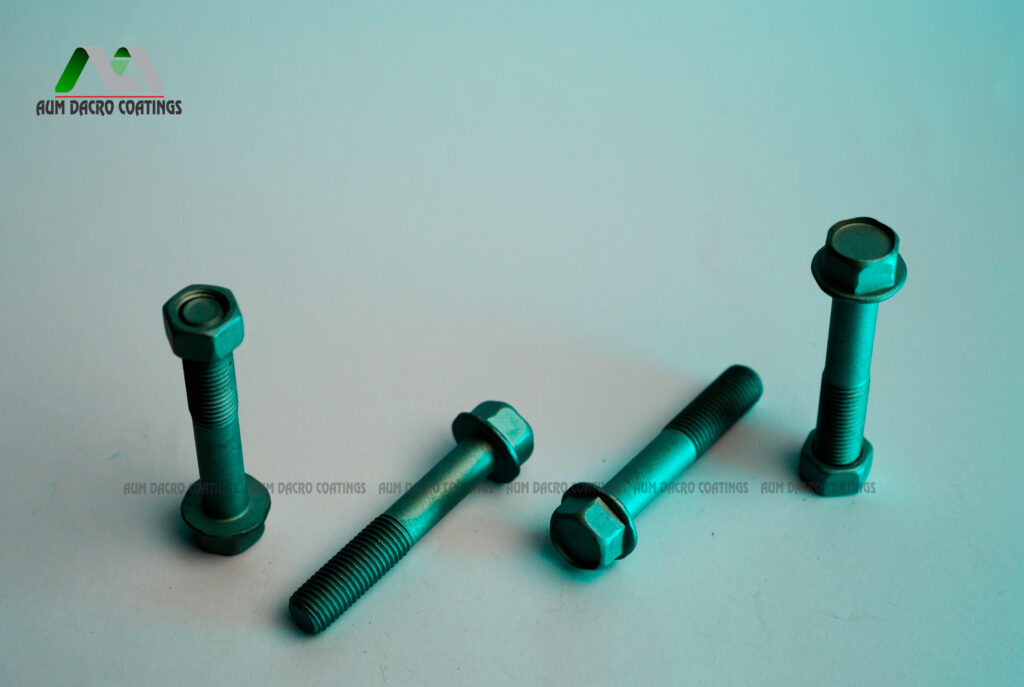
PPG’s XYLAN® Zinc-Flake is an Inorganic, zinc-rich coating that provides corrosion resistance and lubricity on fastener
systems.
Offering good corrosion and chemical resistance, it can be used as a standalone coating or as a primer under various
Xylan topcoats to maximize corrosion performance. Xylan zinc-flake provides low-friction as a single coat and when
combined with a Xylan low-friction topcoat.
Key Benefits of PTFE Coatings
Increased load certainty and scatter reduction
Protection in multiple environments
Extends the life of components in harsh environments
Compatible with many industrial fluids and chemicals
Can be combined with other Xylan grades
Reduces the need for increased thread coating clearance allowances
FUCHS
Dry solid film lubricant
Performance Features
● temperature range: -40 / +110 °C
● meets the requirements of the automotive industry (VDA) for screw lubrication
● is suitable for small bulk parts
● saves assembly time and is particularly suitable for automatic screw-driving systems
● is clean and non-greasing
● has a very good surface adhesion on a large number of materials
● will not affect the efficiency of screw locking systems
● is environmentally and user friendly
● provides an absolutely touch-proof, clear-glossy lubrication film
● contains a UV additive for a UV coating inspection (340-380 nm)
Dry solid film lubricant
Performance Features
● temperature range for the dry film: -40 / +110 °C
● to achieve low friction coefficients/grooving torques for bolted connections, with a low variation
● to avoid seizures of stainless steel connections
● provides a touch-proof and abrasion-resistant clear lubricating film
● is suitable for bulk parts
● saves assembly time and is especially suitable for automatic bolting systems
● is clean and non-greasing
● has a very good surface adhesion on a lot of materials
● contains a UV additive for a UV coating inspection (340 – 380 nm)
MoS2 Dry Film Lubricant
Performance Features
● offers excellent lubrication properties
● saves assembly time
● reliably wets all materials
● allows an easy application by dipping
● permits predictable and repro-ducible assembly results
● fulfils DIN EN 14399 requirements
● protects from corrosion
Heat-curing MoS2 solid film lubricant
Performance Features
● temperature range: -180 / +300 °C
● forms a dry, solid film lubricant
● is resistant to solvents and mineral oils as well as synthetic fluids
● supports oil or grease lubrication
● provides clean assembly conditions
● is resistant to extremely high pressures
● offers corrosion protection
Property
Zinc Flake
PTFE
Zinc Thermal Spray
Alkaline Zinc
Alkaline Zinc Nickel
Hot-Dip Galvanizing (HDG)
Application
Method
Non-electrolytic
(Dip-Spin/Spray)
Spraying,
Coating
Thermal
SprayingVery Good to
Excellent
(Cathodic/Ba
rrier)
Electroplating
Electroplating
Immersion in Molten Zinc
Corrosion
Protection
Level
Excellent
(Cathodic/Barrie
r)
Good to
Excellent
(Barrier)
Very Good to
Excellent
(Cathodic/Ba
rrier)
Good
(Cathodic)
Superior
(Cathodic)
Excellent
(Cathodic/Barr
ier)
Thickness Range ($\mu$m)
Thin (5-15)
Varies
greatlyGood to
Excellent
(Barrier)
Thick
(50-500)
Thin (5-20)
Thin (5-15)
Thick (45-200)
Unique
Selling
Proposition
(USP)
Absence of
Hydrogen
Embrittlement
Risk (Ideal for
high-strength
steel fasteners)
Extremely Low Coefficient of Friction (Non-Stick) & Excellent Chemical Resistance
Ability to
Coat
Extremely
Large
Structures
On-Site
Exceptional
Throwing
Power and
Uniform
Coverage on
Complex
Parts
Highest
Corrosion
Resistance of
Electroplated
Coatings
(Often >1000
hrs salt spray)
Metallurgical
Bond & Most
Cost-Effectiv
e Long-Term
Solution for
Structural
Steel