




Anjali
Introduction
Corrosion is one of the biggest challenges for manufacturers across automotive, construction, renewable energy, railways, and heavy engineering. The right corrosion protection system directly affects component durability, maintenance costs, and product lifespan.
Two of the most widely used technologies are Zinc Flake Coating and Hot Dip Galvanizing (HDG). Both protect steel against corrosion, but they differ significantly in coating thickness, application process, weight, environmental compliance, and suitability for precision components. This guide compares the two so you can choose the right method for your application.
What Is Zinc Flake Coating?
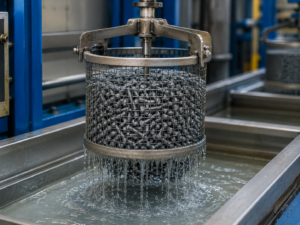
Zinc flake coating is a non-electrolytic system made of microscopic zinc and aluminium flakes suspended in a binder, applied by dip-spin or spray and heat-cured into a thin, durable layer. Because it uses no electric current, it does not generate hydrogen during application — making it ideal for high-strength fasteners and safety-critical parts.
Key benefits of zinc flake coating:
- Superior corrosion resistance
- Chromium-free formulations
- Excellent thread compatibility
- Lightweight coating
- No hydrogen embrittlement
- Controlled friction characteristics
- OEM-approved for automotive applications
It is widely used on automotive fasteners, chassis components, wind energy hardware, railways, and industrial assemblies.
What Is Hot Dip Galvanizing?
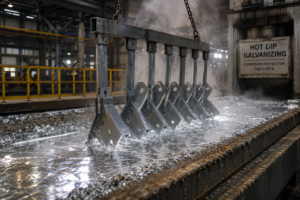
Hot Dip Galvanizing (HDG) immerses cleaned steel components in molten zinc at approximately 450°C. The zinc reacts metallurgically with the steel to form a thick zinc-alloy coating that acts as both a barrier and a sacrificial layer, protecting the steel even when the surface is scratched.
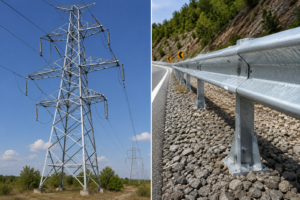
HDG is widely used for large structural steel exposed to outdoor environments, such as transmission towers, structural steel, highway guardrails, utility poles, and construction hardware.
How They Work
Zinc flake coating — thin inorganic layer providing barrier protection, sacrificial zinc protection, controlled friction, and excellent adhesion with precise thickness.
Hot dip galvanizing — thick zinc-alloy layer providing sacrificial and barrier protection through a metallurgical bond, with heavy zinc build-up.
Manufacturing Process Comparison
Zinc flake: cleaning → degreasing → shot blasting/pretreatment → dip-spin or spray → flash-off drying → controlled curing → thickness inspection → salt spray testing → quality inspection.
HDG: degreasing → pickling → flux treatment → molten zinc immersion → cooling → inspection → thickness measurement.
HDG uses high-temperature immersion; zinc flake uses precision-controlled application that preserves dimensional accuracy.
Coating Thickness
| Property | Zinc Flake Coating | Hot Dip Galvanizing |
|---|---|---|
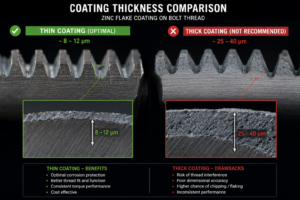
| Typical thickness | 8–20 µm | 45–120 µm |
| Dimensional accuracy | Excellent | Moderate |
| Thread compatibility | Excellent | Difficult |
| Precision components | Highly suitable | Limited |
The thin coating makes zinc flake ideal for threaded fasteners and parts with tight tolerances.
Corrosion Resistance
Corrosion resistance is evaluated using ASTM B117 or ISO 9227 salt spray testing.
| Property | Zinc Flake Coating | Hot Dip Galvanizing |
|---|---|---|
| White rust | Excellent resistance | Moderate |
| Red rust | 1,000–2,000+ hrs | 500–1,000 hrs |
| Automotive durability | Excellent | Limited |
| Industrial durability | Excellent | Excellent |
Weight Impact
| Property | Zinc Flake | HDG |
|---|---|---|
| Added weight | Low | High |
| Lightweight design | Excellent | Moderate |
| Suitable for EV components | Yes | Limited |
The thin coating adds minimal weight — important for automotive, EV, and precision engineering.
Hydrogen Embrittlement
Zinc flake coating generates no hydrogen and is safe for high-strength fasteners, which is why automotive OEMs prefer it.
Hot dip galvanizing does not inherently create hydrogen, but acid pickling during surface preparation can introduce hydrogen if not properly controlled — so process management is important for high-strength steels.
For safety-critical fasteners, zinc flake coating is generally preferred.
Torque & Thread Consistency
Zinc flake: controlled coefficient of friction, excellent torque consistency, minimal thread interference. HDG: thick zinc layer often requires thread oversizing, causes higher torque variation, and may need additional machining.
Applications at a Glance
| Application | Zinc Flake Coating | Hot Dip Galvanizing |
|---|---|---|
| Automotive fasteners, chassis, brakes, EV parts | Excellent | Limited |
| Wind energy: precision fasteners, nacelle bolts | Excellent | — |
| Wind energy: towers, external structures | — | Excellent |
| Construction: structural fasteners, anchor bolts | Preferred | — |
| Construction: beams, bridges, towers, poles | — | Excellent |
Cost Comparison
| Cost factor | Zinc Flake | HDG |
|---|---|---|
| Initial cost | Medium | Low |
| Maintenance cost | Low | Medium |
| Replacement frequency | Low | Higher |
| Lifecycle cost | Lower | Moderate |
Higher corrosion resistance and lower maintenance often make zinc flake coating more economical over the product lifecycle.
Complete Comparison Table
| Property | Zinc Flake Coating | Hot Dip Galvanizing |
|---|---|---|
| Thickness | 8–20 µm | 45–120 µm |
| Salt spray | 1,000–2,000+ hrs | 500–1,000 hrs |
| Weight increase | Low | High |
| Thread fit | Excellent | Difficult |
| Hydrogen embrittlement | None during coating | Process control needed during pickling |
| Automotive use | Excellent | Limited |
| Wind energy | Excellent | Excellent |
| Construction | Good | Excellent |
| OEM approval | Yes | Limited |
| Rework | Easy | Difficult |
| Environmental compliance | Excellent | Good |
Which Coating Should You Choose?
Choose zinc flake coating for automotive fasteners, precision components, lightweight parts, high corrosion resistance, controlled friction, thin coating, chromium-free chemistry, and OEM-approved requirements.
Choose hot dip galvanizing for large structural steel, outdoor infrastructure, utility towers, bridges, and heavy construction.
Frequently Asked Questions
Is zinc flake coating better than hot dip galvanizing? For automotive fasteners, precision components, and OEM applications, zinc flake coating is generally preferred for its thin coating, corrosion resistance, and controlled friction. HDG is better suited to large structural steel.
Does zinc flake coating prevent hydrogen embrittlement? Yes. It is a non-electrolytic process and avoids hydrogen embrittlement during coating, making it suitable for high-strength fasteners.
Which coating lasts longer? Zinc flake systems can provide 1,000–2,000+ hours of salt spray resistance; HDG typically offers 500–1,000 hours, depending on thickness and conditions.
Which is more environmentally friendly? Modern zinc flake coatings are typically chromium-free and comply with REACH, RoHS, and ELV.
Is zinc flake coating suitable for threaded fasteners? Yes. Its thin, uniform coating ensures excellent thread fit and consistent torque without extensive reworking.
Conclusion
Both zinc flake coating and hot dip galvanizing are proven technologies, but they serve different purposes. HDG remains excellent for large structural steel and outdoor infrastructure, while zinc flake coating is the preferred choice for automotive fasteners, precision components, renewable energy hardware, and any application needing high corrosion resistance with minimal impact on dimensions.
At Aum Dacro Coatings, we specialise in advanced zinc flake coating solutions that meet global OEM specifications and support automotive, wind energy, heavy engineering, and infrastructure industries — helping you improve reliability, extend service life, and reduce maintenance costs.