




Anjali
Introduction
Corrosion is a leading cause of equipment failure, maintenance cost, and reduced service life. From automotive fasteners to renewable energy systems, manufacturers rely on the Salt Spray Test (SST) to evaluate how well protective coatings perform under accelerated corrosive conditions.
But a common question comes up again and again: what does a 240-hour, 480-hour, 720-hour, or 1000+ hour salt spray rating actually mean? Does a higher number always mean a better coating? The answer is more nuanced than the numbers alone.
This guide explains the salt spray test, ASTM B117, ISO 9227, white rust vs red rust, OEM requirements, and how to interpret SST hours when selecting a corrosion protection system.
What Is a Salt Spray Test?
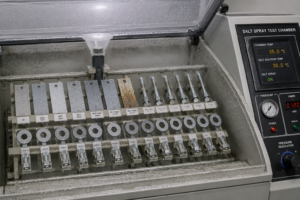
A salt spray test (SST), also called a salt fog test, is an accelerated laboratory corrosion test. Samples are placed in a sealed chamber and continuously exposed to a fine mist of sodium chloride solution under controlled temperature and humidity, simulating corrosive environments in a much shorter time than natural outdoor exposure.
It is widely used for automotive fasteners, chassis components, industrial hardware, wind energy equipment, railway and marine components, construction fasteners, and zinc flake coated parts.
Why Salt Spray Testing Matters
Corrosion can cause structural failures, safety risks, higher maintenance costs, warranty claims, and downtime. Salt spray testing lets manufacturers compare coating performance before products reach the field, supporting faster validation, OEM qualification, supplier approval, and continuous quality improvement.
Understanding ASTM B117
ASTM B117 is the world’s most widely recognised salt spray standard. Developed by ASTM International, it defines standardised test conditions, specifying salt concentration (typically 5% NaCl), chamber temperature (35°C), spray pressure, pH range, test duration, sample positioning, and inspection procedures. Because every lab follows the same procedure, results can be compared consistently.
What Is ISO 9227?
ISO 9227 is the international equivalent of ASTM B117 and is commonly specified by European and global OEMs. The principles are similar, ensuring consistent corrosion testing worldwide. Many automotive manufacturers require compliance with both standards.
How a Salt Spray Test Is Performed
- Clean the test sample
- Apply the specified coating
- Place the sample in the salt spray chamber
- Expose to continuous salt fog
- Inspect periodically
- Record white rust formation
- Record red rust formation
- Report total hours to failure
White Rust vs Red Rust
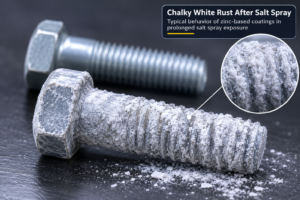
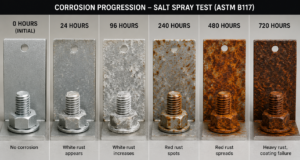
White rust is the first visible sign of corrosion on zinc-based coatings — a chalky white deposit formed when zinc reacts with moisture and oxygen. Importantly, white rust does not mean the steel is corroding; it shows the zinc coating is sacrificing itself to protect the base metal.
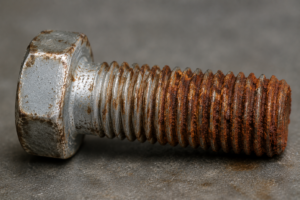
Red rust occurs when the coating has been consumed and the underlying steel begins to corrode. Red rust is generally the primary failure criterion in salt spray testing, and most OEM specifications define performance by hours to red rust.
Understanding SST Hours
SST hours represent how long a coated sample withstands continuous exposure before reaching a defined corrosion stage.
| SST Hours | Typical Application |
|---|---|
| 240 hrs | Indoor applications |
| 480 hrs | Light industrial equipment |
| 720 hrs | Automotive components |
| 1,000 hrs | Heavy automotive & industrial |
| 1,500+ hrs | Marine & highly corrosive environments |
Higher ratings generally indicate better corrosion resistance, but they should always be interpreted alongside coating type, thickness, and service environment.
Do More SST Hours Always Mean Better Performance?
Not necessarily. Real-world corrosion performance also depends on coating chemistry, surface preparation, coating thickness, component geometry, installation conditions, environmental exposure, and maintenance. Two coatings with the same rating can behave differently in the field due to formulation and application quality.
Salt Spray Requirements for Automotive OEMs
| Component | Minimum SST Requirement |
|---|---|
| Interior brackets | 240 hrs |
| Engine compartment parts | 480 hrs |
| Chassis fasteners | 720 hrs |
| Suspension components | 1,000 hrs |
| EV battery hardware | 1,000–1,500+ hrs |
Many OEMs also require controlled friction, adhesion testing, and cyclic corrosion tests in addition to salt spray.
Common Misconceptions
Myth 1: Higher SST hours always mean a better coating. Formulation, adhesion, and application quality also matter. Myth 2: Salt spray testing predicts exact service life. It is an accelerated lab test; real service life depends on operating conditions. Myth 3: All coatings with the same SST rating perform identically. Different technologies can reach similar hours but behave differently in the field.
Selecting a Coating by SST Requirement
| Requirement | Recommended Coating |
|---|---|
| Up to 240 hrs | Zinc plating |
| Up to 480 hrs | Enhanced zinc coatings |
| 720 hrs | Zinc flake coating |
| 1,000+ hrs | Premium zinc flake coating |
| 1,500+ hrs | Multi-layer zinc flake systems |
Why Zinc Flake Coatings Perform Well in Salt Spray Tests
Modern zinc flake coatings consistently achieve high salt spray performance because they provide barrier protection, sacrificial zinc protection, excellent adhesion, uniform thickness, chromium-free chemistry, and no hydrogen embrittlement. These characteristics make them the preferred choice for automotive, renewable energy, heavy engineering, and industrial fasteners.
Frequently Asked Questions
What is a salt spray test? An accelerated corrosion test that evaluates the corrosion resistance of coated or metallic components under controlled laboratory conditions.
What does 1,000 hours salt spray test mean? The coated component withstood roughly 1,000 hours of continuous salt fog exposure before reaching the specified failure criterion, usually red rust.
What is ASTM B117? The internationally recognised standard that defines the procedure for neutral salt spray testing.
What is the difference between white rust and red rust? White rust is corrosion of the zinc coating; red rust indicates corrosion of the underlying steel substrate.
Is salt spray testing the same as real-world corrosion? No. It is an accelerated laboratory method for comparison. Actual field performance depends on environment, coating quality, and maintenance.
Conclusion
The salt spray test remains one of the most important methods for evaluating corrosion protection across automotive, industrial, renewable energy, and infrastructure applications. Understanding what 240, 480, 720, 1,000, and 1,500+ SST hours represent helps manufacturers make informed coating decisions — as long as results are read alongside real-world conditions, component design, and OEM specifications.
At Aum Dacro Coatings, we specialise in advanced zinc flake coating solutions engineered to meet stringent automotive and industrial corrosion requirements, delivering strong salt spray performance and compliance with global quality standards. For guidance on selecting the right coating for your application, connect with our team.