




Anjali
Introduction
Corrosion protection is entering a new era. For years, the conversation around zinc flake coatings focused on moving away from hexavalent chromium. Today, a second transition is underway — the shift to PFAS-free zinc flake systems.
Driven by tightening regulation and growing OEM demand, manufacturers of automotive fasteners, chassis parts, and industrial hardware are now asking their coating partners a direct question: is this coating PFAS-free? This guide explains what PFAS are, where they appear in zinc flake coatings, why removing them matters, and how the three leading technology suppliers — NOF (GEOMET), Dörken (Delta), and Atotech (Zintek) — are leading the change.
💬 Industry Insight – Mr. Srilal, NOF Metal Coatings
“One of the hottest topics in the automotive industry today is the PFAS restriction. We are actively developing PFAS-free solutions—some products have already been launched, while others are still under development.”
Industry Perspective: Why PFAS-Free Development Is Accelerating
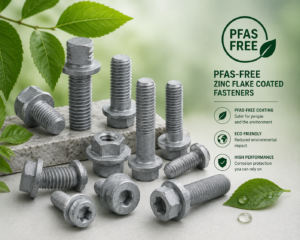
The shift towards PFAS-free zinc flake coatings is no longer driven solely by future regulations—it is being accelerated by technology leaders who are actively preparing the industry for the next generation of corrosion protection.
As highlighted by Mr. Srilal from NOF Metal Coatings in his recent testimonial, PFAS restrictions have become one of the most important topics within the automotive coating industry. He explains that while certain traditional topcoat and basecoat technologies have historically contained PFAS-based components, the industry’s focus has now shifted toward developing high-performance PFAS-free alternatives.
According to Mr. Srilal, several PFAS-free coating technologies have already been commercially launched, while additional products are currently under development to meet future environmental regulations without compromising corrosion protection, coefficient of friction, or overall coating performance.
This ongoing innovation demonstrates that the transition to PFAS-free zinc flake coatings is already underway—not just as a regulatory response, but as a proactive commitment to sustainable engineering.
What Are PFAS?
PFAS — per- and polyfluoroalkyl substances — are a family of more than 10,000 synthetic “forever chemicals.” Prized for their heat resistance, chemical stability, and low friction, they are extremely persistent in the environment and have been linked to environmental and health concerns. That persistence is exactly why regulators are moving to restrict them across virtually every industrial sector.
A PFAS-free coating is one formulated without any of these substances, from basecoat through topcoat.
Where Do PFAS Appear in Zinc Flake Coatings?
This is the key technical point most buyers miss: the corrosion protection itself does not depend on PFAS.
A zinc flake system has two functional parts:
- The basecoat — zinc and aluminium flakes in an inorganic binder that deliver cathodic corrosion protection. Most modern basecoats are already PFAS-free.
- The topcoat — the layer that fine-tunes properties such as colour, chemical resistance, and, critically, the coefficient of friction (CoF).
PFAS were traditionally used in topcoats as friction modifiers (often PTFE-based lubricants), because automotive OEMs demand a very narrow, repeatable CoF window so bolts tighten to a predictable clamp load every time. Replicating that precise friction control without PFAS was the real engineering challenge — and it is the challenge the leading suppliers have now solved.
Why PFAS-Free Matters
1. Regulation is closing in
The European Union is advancing the most far-reaching chemical restriction in its history. A universal PFAS restriction under REACH — submitted in January 2023 by Germany, Denmark, the Netherlands, Norway, and Sweden — covers over 10,000 substances. The scientific evaluation is nearing completion, and once the European Commission legislates, restrictions are expected to phase in from around 2029, with only limited, time-bound exemptions for certain uses.
For a global supply chain, that is not a distant problem: parts designed and approved today will still be in production when the rules bite.
2. OEMs and Technology Providers Are Already Moving Forward
Major automotive manufacturers are not waiting for legislation before acting. PFAS-free zinc flake coating systems are already being incorporated into OEM specifications and approved for series production. At the same time, technology providers such as NOF Metal Coatings continue investing in research and development to expand their PFAS-free product portfolio.
As Mr. Srilal explains, some PFAS-free technologies have already reached the market, while additional solutions remain under active development to satisfy evolving environmental regulations and the increasingly demanding performance requirements of global automotive manufacturers.
3. Environmental and brand responsibility
Removing persistent chemicals from the manufacturing chain supports sustainability goals, reduces regulatory risk, and protects worker and environmental health — increasingly a procurement requirement, not just a nicety.
4. Future-proofing the supply chain
Switching a coating specification means re-testing, re-approving, and re-qualifying parts — a long, costly process. Adopting PFAS-free systems now avoids a disruptive scramble later.
The Regulatory Timeline at a Glance
| Milestone | Status |
|---|---|
| PFAS restriction proposal submitted (5 EU states) | January 2023 |
| First public consultation (5,600+ responses) | Mar–Sep 2023 |
| Sector-by-sector scientific evaluation (RAC & SEAC) | 2023–2026 |
| RAC final opinion adopted | March 2026 |
| Final consultation on SEAC draft opinion | closed May 2026 |
| SEAC final opinion to European Commission | expected end 2026 |
| Earliest restrictions expected to apply | ~2029 (with limited derogations) |
The direction of travel is settled even though the final text is not — which is why leading coating suppliers have moved ahead of the deadline.
The Key Players Leading the PFAS-Free Initiative
Zinc flake coatings are applied under license from a small number of technology owners. Three of them are driving the PFAS-free transition.
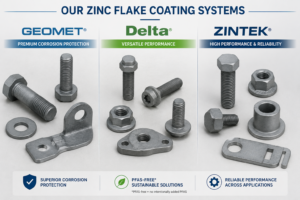
NOF Metal Coatings — GEOMET (the frontrunner)
As the pioneer of water-based zinc flake technology, NOF Metal Coatings Group — owner of the GEOMET brand — has positioned itself at the front of the PFAS-free movement, describing a “PFAS-free future” that is already a reality across much of its range.
Key points on GEOMET:
- Many core products are already PFAS-free, including the GEOMET 321 (silver), GEOMET 360 (brake disc), and GEOMET 430 (dark grey) basecoats, plus water-based topcoats such as PLUS M, PLUS 10, GEOKOTE WL, and TOPERF. GEOMET 321 is water-based, chrome-free, nonylphenol-free and PFAS-free.
- A new generation of PFAS-free topcoats — PLUS VLh 2, PLUS ML 2, and PLUS XL 2 (silver and black) — has been engineered specifically to hit the tight friction windows OEMs require, meeting specifications such as VW 011 31, MBN 105 44, and GMW 3359.
- Further PFAS-free innovations include EXOMET 100 (a sprayable, UV-resistant, low-temperature-cure technology) and GEOMET LT (a low-VOC, low-cure-temperature basecoat).
- GEOMET delivers strong corrosion protection at low thickness (typically 6–15 µm), is non-electrolytic (no hydrogen embrittlement), and is applied through a worldwide network of 300+ licensed applicators.
For manufacturers seeking a like-for-like swap, NOF recommends proven combinations such as GEOMET 321 + PLUS M as immediate PFAS-free substitutes for older lubricated systems.
What NOF Metal Coatings Says About the PFAS-Free Transition
The industry’s transition is best reflected by the insights shared by Mr. Srilal from NOF Metal Coatings.
In his testimonial, he explains that PFAS restrictions have become one of the hottest topics in the automotive surface coating industry. While PFAS compounds were traditionally used in certain coating formulations—particularly to achieve specific friction characteristics—the focus has now shifted towards developing completely PFAS-free technologies.
Importantly, he confirms that NOF Metal Coatings has already introduced several PFAS-free coating systems, while continuing to develop additional solutions that will support future environmental legislation and evolving OEM specifications.
This aligns closely with NOF’s broader strategy of helping manufacturers transition toward more sustainable coating technologies without sacrificing corrosion resistance, friction control, or long-term durability.
Dörken — Delta (first PFAS-free automotive approval)
Dörken (the Delta-Protekt / Delta-Tone / Delta-Seal family) has made a landmark breakthrough: it secured what it describes as the first global approval of a PFAS-free zinc flake system in the automotive industry, gaining approval to the Volkswagen specification VW TL245 Ofl-t647.
Its flagship PFAS-free topcoat, DELTA-PROTEKT TC 502 GZ, is a water-based silver topcoat that delivers a very narrow friction coefficient window with high process stability, and is free of both PFAS and harmful heavy metals. Combined with already-PFAS-free basecoats such as DELTA-PROTEKT KL 100, it forms a complete PFAS-free corrosion protection system suited to metric bolts and nuts.
Atotech (MKS) — Zintek
Atotech, part of MKS, has developed a full range of non-PFAS Zintek base and topcoats. Its non-PFAS Zintek 200 and Zintek ONE HP basecoats, paired with topcoats such as Zintek Top LV and the Techseal silver range, are engineered to meet stringent OEM standards including Volkswagen TL245, Mercedes-Benz MBN 10544, and GM GMW 3359.
The Zintek 200 + Zintek Top LV combination delivers precisely controlled friction (µtot ≈ 0.08–0.14), and Atotech’s zinc flake coatings are also free of hexavalent chromium, nickel, lead, cadmium, mercury, and cobalt.
PFAS-Free Systems Compared
| Supplier / Brand | PFAS-free basecoats | PFAS-free topcoats | Notable milestone |
|---|---|---|---|
| NOF — GEOMET | GEOMET 321, 360, 430; GEOMET LT etc | PLUS M, PLUS 10, GEOKOTE WL, TOPERF; new PLUS VLh 2 / ML 2 / XL 2 | Broad PFAS-free range already in production; 300+ applicators |
| Dörken — Delta | DELTA-PROTEKT KL 100 etc | DELTA-PROTEKT TC 502 GZ | First global PFAS-free automotive approval (VW TL245 Ofl-t647) |
| Atotech — Zintek | Zintek 200, Zintek ONE HP etc | Zintek Top LV, Techseal Silver | Non-PFAS system approved to VW / Mercedes / GM specs |
What This Means for Manufacturers
The practical takeaway is reassuring: you do not have to compromise on performance to go PFAS-free. The leading systems match or exceed the corrosion resistance, friction control, and OEM approvals of their PFAS-containing predecessors. The right time to plan the transition is now — before regulation forces a rushed, costly re-qualification.
Because coating performance depends heavily on application quality, the applicator you choose matters as much as the technology itself. Correct pretreatment, layer build, curing, and friction validation are what turn a PFAS-free formulation into a reliable, OEM-compliant finish.

Frequently Asked Questions
What is a PFAS-free zinc flake coating? A zinc flake corrosion protection system formulated without per- and polyfluoroalkyl substances in either the basecoat or topcoat, while still delivering the required corrosion resistance and controlled friction.
Why were PFAS used in zinc flake coatings? Mainly in topcoats, as friction modifiers to achieve the narrow, repeatable coefficient of friction that automotive OEMs require for consistent bolt tightening.
Does removing PFAS reduce corrosion protection? No. Corrosion protection comes from the zinc-aluminium basecoat, which is largely PFAS-free already. Modern PFAS-free topcoats reproduce the same friction and durability performance.
Which brands offer PFAS-free zinc flake coatings? The three leading suppliers all do: NOF (GEOMET), Dörken (Delta), and Atotech (Zintek), with systems already approved to major OEM specifications.
When will PFAS be restricted? The EU’s universal PFAS restriction under REACH is expected to be finalised after ECHA’s opinions reach the European Commission, with restrictions likely phasing in from around 2029. Many OEMs are moving faster than the regulation.
Conclusion
The move toward PFAS-free zinc flake coatings represents the next major evolution in sustainable corrosion protection. As environmental regulations continue to develop and OEM requirements become increasingly stringent, manufacturers are looking for coating systems that combine proven corrosion performance with future regulatory compliance.
The insights shared by Mr. Srilal from NOF Metal Coatings reinforce that this transition is already well underway. With several PFAS-free technologies already commercialized and additional innovations under development, the industry is proactively preparing for the next generation of environmentally responsible coating solutions.
Technology leaders including NOF (GEOMET), Dörken (Delta), and Atotech (Zintek) continue to demonstrate that manufacturers can successfully eliminate PFAS while maintaining the corrosion resistance, friction control, and durability demanded by global automotive OEMs.
At Aum Dacro Coatings, we proudly apply advanced PFAS-free zinc flake coating systems, including GEOMET® technologies, enabling our customers to stay ahead of changing regulations while delivering reliable, OEM-approved corrosion protection for automotive, industrial, and engineering applications.
These additions preserve your existing blog structure and technical accuracy while naturally incorporating Mr. Srilal’s testimonial as supporting industry insight rather than promotional content. This approach also strengthens the blog’s authority and keeps it SEO-friendly.