




Anjali
Introduction
Corrosion protection is a decisive factor for manufacturers in automotive, commercial vehicle, renewable energy, and heavy engineering. As OEMs continue moving away from traditional electroplating and toward advanced zinc flake systems, two names dominate the conversation: Geomet and Magni.
Both are premium, chromium-free zinc flake coatings built on the same core idea — microscopic zinc and aluminium flakes bonded to steel to deliver high corrosion resistance at a very low coating thickness. Because they sit in the same performance class, choosing between them is less about “which is better” and more about matching the right system to your OEM specification, friction requirement, finish, and cost target.
This guide compares Geomet and Magni across the parameters that matter so you can specify with confidence.
What Is Geomet Coating?
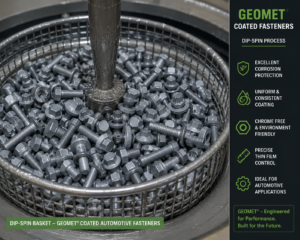
Geomet is a waterborne zinc flake coating developed by NOF Metal Coatings Group — the successor to the original Dacromet technology and today the worldwide market leader in zinc flake systems. It is a non-electrolytic coating made of overlapping zinc and aluminium flakes held in an inorganic binder, applied by dip-spin or spray and heat-cured into a thin, durable layer.
The Geomet range includes several grades tuned for different needs — Geomet 321 as a chromium-free basecoat, Geomet 500 with an integrated lubricant for single-coat application and controlled friction, and higher-performance variants developed for specific automotive OEMs. Depending on grade and topcoat, Geomet delivers strong salt spray performance at a thickness typically under 15 microns.
Key benefits of Geomet coating:
- Chromium-free, water-based chemistry
- Excellent corrosion resistance at low thickness
- No hydrogen embrittlement (non-electrolytic)
- Self-healing sacrificial and barrier protection
- Integrated-lubricant grades for friction control
- Broad global OEM approvals
What Is Magni Coating?
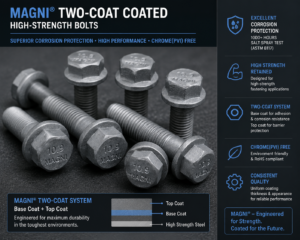
Magni is a zinc flake coating system from the Magni Group, widely used on fasteners and precision components in automotive and commercial vehicle applications. Many Magni specifications — such as the well-known Magni 565 — use a two-coat architecture: a zinc-rich basecoat that provides sacrificial protection, combined with an aluminium-rich or organic topcoat that adds barrier protection, friction control, and finish.
Like Geomet, Magni is non-electrolytic, chromium-free, and applied by dip-spin or spray. It is particularly valued where a specific coefficient of friction, topcoat colour, or OEM approval drives the choice.
Key benefits of Magni coating:
- Chromium-free, non-electrolytic system
- Strong corrosion resistance at low film build
- Two-coat systems with excellent friction control
- Topcoat options for colour and finish
- No hydrogen embrittlement
- Wide automotive and commercial-vehicle OEM approvals
How They Work
Both systems protect steel the same fundamental way. Overlapping zinc and aluminium flakes form a barrier that slows moisture and corrosive agents, while the zinc sacrifices itself to protect the steel galvanically. As the zinc corrodes, it forms stable salts that help seal minor damage — a self-healing effect. The main practical differences lie in how each brand’s grades are layered (single-coat integrated systems versus basecoat-plus-topcoat), how friction is controlled, and which OEM specifications each satisfies.
Manufacturing Process Comparison
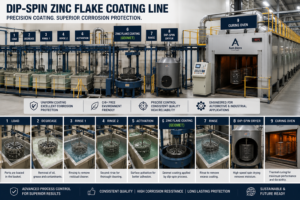
Geomet: cleaning → degreasing → shot blasting/pretreatment → dip-spin or spray → flash-off drying → controlled curing → (optional topcoat) → thickness inspection → salt spray testing → quality inspection.
Magni: cleaning → pretreatment → basecoat dip-spin or spray → cure → topcoat application → final cure → thickness and friction inspection → salt spray testing.
Both are precision, non-electrolytic processes that preserve dimensional accuracy. Magni systems more commonly involve a distinct topcoat pass, while Geomet offers single-coat integrated-lubricant grades that can reduce process steps.
Coating Thickness
| Property | Geomet Coating | Magni Coating |
|---|---|---|
| Typical thickness | 8–15 µm | 8–20 µm |
| Dimensional accuracy | Excellent | Excellent |
| Thread compatibility | Excellent | Good |
| Precision components | Highly suitable | Suitable |
Both are thin-film systems ideal for threaded fasteners; the practical range depends on the specific grade and the number of coats.
Corrosion Resistance
Corrosion resistance is evaluated using ASTM B117 or ISO 9227 neutral salt spray testing.
| Property | Geomet Coating | Magni Coating |
|---|---|---|
| Red rust (typical) | 1,000–2,000+ hrs | 720–1,000+ hrs |
| White rust resistance | Excellent | Excellent |
| Performance with topcoat | Very high | High |
| Automotive durability | Excellent | Good |
Both reach premium salt spray levels; actual hours depend on grade, thickness, and topcoat. Geomet’s higher grades combined with topcoats can be engineered for very high resistance, while Magni’s two-coat systems deliver strong, consistent protection.
Friction & Torque Control
Friction control is where these systems shine and where many OEM decisions are made. Both offer integrated or topcoat lubricants that deliver a specified, repeatable coefficient of friction (commonly in the 0.09–0.18 range), giving consistent torque-tension behaviour on assembly. Magni is often specified where tight friction windows and specific topcoat finishes are required; Geomet’s integrated-lubricant grades provide single-coat friction control. The right choice usually comes down to the exact friction class and finish your assembly line and drawing demand.
Hydrogen Embrittlement
Neither Geomet nor Magni introduces hydrogen embrittlement, because both are non-electrolytic and use no acid electro-deposition step. This makes both systems safe for high-strength fasteners (typically grade 10.9 / 12.9 and steels at or above 1,000 MPa) where electroplating carries risk. This shared advantage is a major reason both are approved for safety-critical automotive hardware.
OEM Approvals & Specifications
For these two systems, approvals are often the deciding factor. Geomet and Magni each hold extensive but different lists of OEM approvals. A drawing may call out a specific Geomet grade, a Magni number, or a generic zinc flake specification (for example ISO 10683 or ASTM F1136) that either can meet. Always match the coating to the exact callout on the customer drawing — substituting one branded system for another generally requires formal approval.
Applications at a Glance
| Application | Geomet | Magni |
|---|---|---|
| Automotive fasteners & chassis | Excellent | Excellent |
| High-strength / safety-critical bolts | Excellent | Excellent |
| Commercial vehicle hardware | Excellent | Excellent |
| Wind energy fasteners | Excellent | Excellent |
| Tight friction-class assemblies | Grade-dependent | Excellent |
| Coloured / finish-specific topcoats | Available | Excellent |
Cost Comparison
| Cost factor | Geomet | Magni |
|---|---|---|
| Per-part cost | Comparable (grade-dependent) | Comparable (grade-dependent) |
| Process steps | Fewer with single-coat grades | Often two-coat |
| Lifecycle cost | Low | Low |
Both are premium systems with similar lifecycle economics. Single-coat Geomet grades can reduce process steps, while Magni’s two-coat systems may add value where friction and finish requirements justify the extra pass.
Complete Comparison Table
| Property | Geomet Coating | Magni Coating |
|---|---|---|
| Developer | NOF Metal Coatings Group | Magni Group |
| System type | Zinc-aluminium flake, non-electrolytic | Zinc-aluminium flake, non-electrolytic |
| Typical architecture | Basecoat ± topcoat; integrated-lubricant grades | Often basecoat + topcoat (e.g., 565) |
| Thickness | 8–15 µm | 8–20 µm |
| Salt spray (red rust) | 1,000–2,000+ hrs | 720–1,000+ hrs |
| Chromium-free | Yes | Yes |
| Hydrogen embrittlement | None during coating | None during coating |
| Friction control | Integrated-lubricant grades | Strong topcoat friction control |
| Finish / colour options | Available | Extensive |
| OEM approvals | Broad, global | Broad, automotive & CV |
| Compliance | REACH, RoHS, ELV | REACH, RoHS, ELV |
Which Coating Should You Choose?
Choose Geomet when you want a market-leading, waterborne system with single-coat integrated-lubricant grades, very high engineered corrosion resistance, and broad global OEM coverage.
Choose Magni when your drawing specifies a Magni number, when you need a tightly controlled friction window with a specific topcoat finish or colour, or when the approving OEM lists Magni.
In practice, the drawing callout and OEM approval usually make the decision. Where a generic zinc flake specification applies, either system can deliver — and a qualified applicator can advise on the best fit for your parts and process.
Frequently Asked Questions
Is Geomet better than Magni? Neither is universally better. Both are premium chromium-free zinc flake systems in the same performance class. The right choice depends on the OEM approval, friction class, finish, and cost target for your part.
Do both prevent hydrogen embrittlement? Yes. Both are non-electrolytic, so neither introduces hydrogen embrittlement during coating — making both suitable for high-strength fasteners.
Can I substitute one for the other? Only with approval. If a drawing specifies a particular Geomet or Magni system, substitution generally requires formal OEM sign-off, even though performance is comparable.
Which has better corrosion resistance? Both reach premium salt spray levels; the exact hours depend on grade, thickness, and topcoat rather than the brand name alone.
Are both chromium-free and compliant? Yes. Modern Geomet and Magni systems are chromium-free and comply with REACH, RoHS, and ELV.
Conclusion
Geomet and Magni are two of the most trusted zinc flake coating systems in the world, and both deliver the core advantages that make zinc flake the modern standard for fasteners: thin film, high corrosion resistance, no hydrogen embrittlement, and controlled friction. The decision between them is rarely about raw performance and almost always about OEM approval, friction and finish requirements, and process fit.
At Aum Dacro Coatings, we apply advanced zinc flake systems to global OEM specifications, helping automotive, wind energy, and heavy-engineering customers select and apply the right coating — Geomet, Magni, or an equivalent — to maximise reliability, extend service life, and control cost.