




Anjali
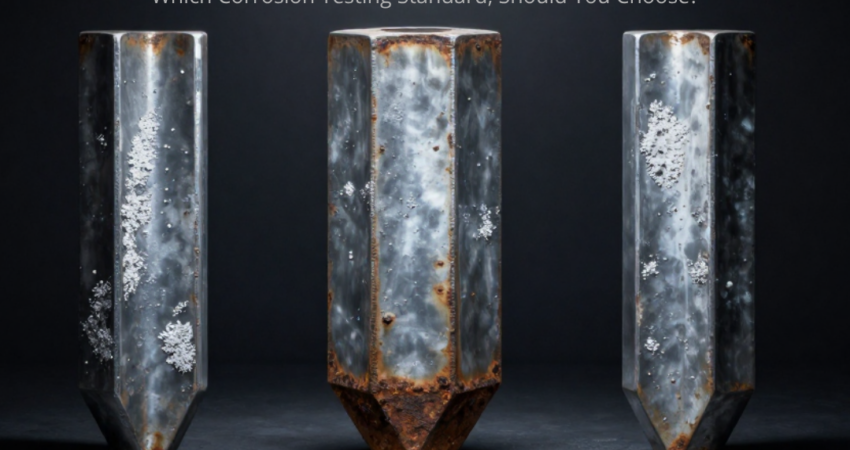
NSST Standards Explained: JIS vs ASTM vs ISO: Which Corrosion Testing Standard Should You Choose?
Introduction
Selecting the right NSST standards is essential for evaluating corrosion resistance and ensuring long-term coating performance. Manufacturers supplying components to automotive, renewable energy, railways, aerospace, construction, and heavy engineering industries rely on Neutral Salt Spray Testing (NSST) to validate protective coatings before products reach the field.
Among the most commonly specified corrosion testing standards are:
- JIS Z 2371
- ASTM B117
- ISO 9227 (NSS)
Although these standards use similar testing conditions, they differ in terms of regional adoption, documentation, and OEM requirements. Understanding the differences between ASTM B117 vs ISO 9227 and JIS standards helps manufacturers select the correct testing protocol and comply with customer specifications.
What Are NSST Standards?
NSST (Neutral Salt Spray Test) standards define a controlled laboratory procedure for evaluating the corrosion resistance of coated metal components under accelerated conditions.
The purpose of NSST is to compare coating performance consistently before products are exposed to harsh operating environments.
During the test:
- A 5% sodium chloride (NaCl) solution is atomized into a fine mist.
- The chamber temperature is maintained at 35°C.
- Components remain exposed for predetermined durations such as 240, 480, 720, 1000, or 1500+ hours.
- After exposure, inspectors evaluate:
- White rust
- Red rust
- Blistering
- Peeling
- Corrosion spread
- Coating degradation
Although salt spray testing cannot perfectly replicate real-world service conditions, it remains the most widely accepted accelerated corrosion testing method worldwide.
Why Are NSST Standards Important?
Using internationally recognized NSST standards helps manufacturers:
- Verify coating performance
- Compare different coating systems
- Meet OEM specifications
- Reduce warranty failures
- Improve product reliability
- Ensure consistent manufacturing quality
- Support export compliance
For industries where corrosion resistance directly impacts product safety and durability, NSST testing is an essential part of quality assurance.
Comparison of NSST Standards: JIS Z 2371, ASTM B117, and ISO 9227
| Parameter | JIS Z 2371 | ASTM B117 | ISO 9227 (NSS) |
|---|---|---|---|
| Salt Solution | 5% NaCl | 5% NaCl | 5% NaCl |
| Chamber Temperature | 35°C | 35°C | 35°C |
| Spray Type | Continuous Fog | Continuous Fog | Continuous Fog |
| pH Range | 6.5–7.2 | 6.5–7.2 | 6.5–7.2 |
| Typical Test Hours | 240–1500+ | 240–1500+ | 240–1500+ |
| Primary Usage | Japan & Asia | USA, India & Global | Europe & Global |
| Common Industries | Automotive, Electronics | Automotive, Fasteners | Automotive, Aerospace |
| Evaluation Method | Customer Specification | ASTM + Customer Specification | ISO + Customer Specification |
Understanding JIS Z 2371

JIS Z 2371 is the Japanese Industrial Standard for neutral salt spray testing.
It is commonly specified by:
- Japanese automotive OEMs
- Tier-1 suppliers
- Electronics manufacturers
- Precision engineering companies
Typical applications include:
- Automotive fasteners
- Transmission components
- Engine hardware
- Industrial machinery
- Electrical components
Many Japanese manufacturers continue to reference JIS standards due to long-established engineering specifications.
Understanding ASTM B117
Among all NSST standards, ASTM B117 is the most widely recognized across North America, India, and many international industries.
It is commonly used for evaluating:
- Zinc flake coatings
- Electroplated components
- Fasteners
- Automotive hardware
- Industrial components
- Structural assemblies
At Aum Dacro Coatings, corrosion testing is performed according to ASTM B117, ensuring reliable quality control and compliance with customer requirements.
Understanding ISO 9227

ISO 9227 (Neutral Salt Spray – NSS) provides internationally accepted procedures for accelerated corrosion testing.
It is frequently required by:
- European automotive manufacturers
- Aerospace companies
- Wind energy manufacturers
- Export-oriented industries
- Heavy engineering companies
ISO 9227 ensures consistent testing practices across international supply chains.
ASTM B117 vs ISO 9227 – Is There a Difference?
Many engineers ask whether ASTM B117 vs ISO 9227 produces different corrosion results.
The answer is not significantly.
Both standards specify:
- 5% NaCl solution
- 35°C chamber temperature
- Continuous fog
- Similar pH limits
The biggest difference lies in:
- Documentation
- Regional acceptance
- Customer specifications
- OEM requirements
Performance results are generally comparable when testing conditions remain consistent.
Which NSST Standards Should You Choose?
The correct choice depends entirely on your customer’s specification.
| Customer Type | Recommended Standard |
|---|---|
| Japanese OEM | JIS Z 2371 |
| American OEM | ASTM B117 |
| Indian Automotive | ASTM B117 |
| European OEM | ISO 9227 |
| Export Manufacturing | ISO 9227 |
| Global Tier-1 Suppliers | Customer Requirement |
Selecting the correct standard ensures compliance with international quality expectations.
Why NSST Standards of Corrosion Testing Matters?
Regular corrosion testing provides several long-term benefits:
- Validates coating consistency
- Improves product life
- Reduces maintenance costs
- Minimizes field failures
- Builds customer confidence
- Meets global OEM standards
- Supports quality certifications
Manufacturers using advanced zinc flake coatings depend on NSST testing to guarantee long-term durability.
Why Choose Aum Dacro Coatings for NSST Standards?
At Aum Dacro Coatings, corrosion protection extends beyond coating application.
Our quality capabilities include:
- ASTM B117 Neutral Salt Spray Testing
- High-performance Zinc Flake Coatings
- Automotive OEM-approved coating systems
- PFAS-Free & Chromium-Free coating technologies
- Advanced inspection laboratories
- Expert technical consultation
- Corrosion testing support
- Solutions for automotive, renewable energy, railways, construction, and industrial engineering
Our goal is to deliver coating systems that consistently perform in demanding environments.
NSST Standards at a Glance
| Standard | Best For | Common Region |
|---|---|---|
| JIS Z 2371 | Japanese OEMs | Japan & Asia |
| ASTM B117 | Automotive & Fasteners | USA, India |
| ISO 9227 | Global Export & European OEMs | Europe & Worldwide |
Frequently Asked Questions
What are NSST Standards?
NSST standards define internationally accepted procedures for Neutral Salt Spray Testing to evaluate the corrosion resistance of coated metal components.
What is ASTM B117?
ASTM B117 is one of the world’s most widely used accelerated corrosion testing standards for evaluating protective coatings such as zinc flake coatings and electroplating.
What is the difference between ASTM B117 and ISO 9227?
ASTM B117 and ISO 9227 use nearly identical testing conditions. The primary differences involve documentation, regional adoption, and OEM specifications rather than testing performance.
Which industries use NSST Standards?
NSST standards are widely used in automotive, aerospace, renewable energy, railways, construction, industrial manufacturing, and fastener production.
Why does Aum Dacro Coatings use ASTM B117?
Aum Dacro Coatings performs corrosion testing according to ASTM B117 to ensure reliable coating performance, consistent quality, and compliance with customer and OEM requirements.
Conclusion
Selecting the right NSST standards is essential for ensuring coating reliability, product durability, and compliance with customer specifications. Whether your project requires JIS Z 2371, ASTM B117, or ISO 9227, understanding their similarities and regional requirements helps manufacturers make informed decisions.
At Aum Dacro Coatings, we combine advanced ASTM B117 corrosion testing, high-performance zinc flake coating systems, and technical expertise to deliver reliable corrosion protection for automotive, renewable energy, railways, construction, and industrial applications.
If you’re looking for expert guidance on selecting the right corrosion testing standard or coating system, contact Aum Dacro Coatings today. Our team is ready to help you achieve long-term performance, global compliance, and superior corrosion resistance.
For more Information – CLICK ME!